Cyber insurance has become an essential component of modern risk management. Organizations invest heavily in cybersecurity technologies, employee awareness training, incident response planning, and insurance coverage designed to protect against increasingly sophisticated threats. These investments are necessary because the financial consequences of a breach, ransomware attack, or business interruption event can be substantial.
As a result, many employers believe they have taken the appropriate steps to protect both their organization and their workforce. The challenge is that cybercriminals have evolved their tactics. Rather than focusing exclusively on networks, servers, and applications, attackers increasingly target the people who work inside organizations. Employees have become one of the most attractive attack surfaces available because they often possess the information criminals value most.
One of the most valuable assets a criminal can obtain is a Social Security Number. Unlike a password, it cannot simply be reset after a breach. Unlike a credit card, it does not expire. Once exposed, a Social Security Number can remain useful to criminals for years, creating risks that extend far beyond traditional credit fraud.
Most organizations understand the connection between a stolen Social Security Number and financial identity theft. What many fail to recognize is the growing connection between Social Security Number breaches and tax identity theft. This distinction matters because many of the protections employers provide today were never designed to address tax-related fraud.
The Traditional Breach Response Playbook
When a data breach involves employee records, payroll information, or Social Security Numbers, organizations often follow a familiar response process. Notification letters are sent, legal requirements are satisfied, and affected individuals are offered credit monitoring services. For years, this approach represented industry best practice and demonstrated a commitment to helping affected individuals monitor for signs of financial fraud.
Credit monitoring remains an important tool because it helps consumers identify suspicious activity involving credit reports, loan applications, and new account creation. Many forms of financial fraud can be detected quickly through these services, allowing victims to take action before significant damage occurs. There is real value in this protection, and it should continue to be a key component of any post-breach response strategy.
The challenge is that today’s cybercriminals are not limiting themselves to activities that trigger credit bureau alerts. A stolen Social Security Number can be used to file fraudulent tax returns, claim tax refunds, create employment-related identity fraud, access government benefits, or obtain taxpayer information. In many of these situations, the victim may receive no warning until months after the fraud has already occurred.
As a result, organizations that believe they have fully addressed post-breach protection may unknowingly be leaving employees exposed to a growing category of risk.
Why Credit Monitoring Doesn’t Tell the Whole Story
Credit monitoring does exactly what it was designed to do. It monitors activity related to an individual’s credit profile and alerts consumers when significant changes occur. Common examples include new credit inquiries, new credit card accounts, loan applications, collection activity, and changes to personal information contained within a credit report.
These services provide meaningful protection against many forms of financial fraud. However, they were not designed to monitor taxpayer activity.
Consider what happens when a criminal uses a stolen Social Security Number to file a fraudulent tax return. The IRS processes the return, the criminal receives the refund, and the victim discovers the fraud months later while attempting to file a legitimate return. What happened to the victim’s credit report? Nothing. There was no credit inquiry, no new loan application, and no new credit account. The fraud occurred entirely outside the systems credit monitoring was designed to monitor.
This distinction is important because many employers assume that if they provide credit monitoring, they have adequately addressed identity theft risk. In reality, a significant category of fraud may remain completely invisible.
The Growing Threat of Tax Identity Theft
Tax identity theft occurs when a criminal uses another person’s taxpayer information to commit tax-related fraud. While refund theft is often the most visible example, the problem extends far beyond fraudulent tax filings.
Criminals may use stolen taxpayer information to manipulate wage reporting, create employment identity fraud, access taxpayer records, trigger compliance issues, or interfere with legitimate interactions with tax authorities. Victims frequently discover these problems only after receiving an IRS notice, experiencing a delayed refund, or encountering unexpected complications during tax season.
The consequences can be substantial. Individuals often spend years working with the IRS, employers, financial institutions, and government agencies to resolve the issue. The process can be frustrating, time-consuming, and emotionally exhausting. In some cases, victims may face delayed mortgage approvals, disrupted financial plans, unexpected legal expenses, or ongoing concerns about the misuse of their personal information.
For many employees, tax identity theft becomes far more than a financial inconvenience. It becomes a source of stress that affects both their personal and professional lives.
Why Tax Identity Theft Is Becoming an Employer Problem
At first glance, tax identity theft appears to be a personal issue. In reality, it often becomes an organizational issue as well.
When employees become victims of identity theft, employers frequently become involved in the resolution process. Human Resources teams may need to assist with employment verification. Payroll departments may be asked to investigate wage reporting discrepancies. Managers may experience productivity challenges as employees spend time dealing with tax authorities, financial institutions, and legal advisors.
The consequences often include lost productivity, increased administrative burden, employee stress, absenteeism, and reduced workplace engagement. In today’s competitive labor market, employers are paying closer attention to anything that affects employee well-being, retention, and performance.
Organizations have long recognized that employee well-being impacts business performance. That is why employers invest in healthcare benefits, retirement planning, financial wellness programs, employee assistance programs, and mental health resources. Tax identity theft represents another area where employee well-being and organizational performance intersect.
The Evolution of Workforce Protection
The concept of workforce protection has expanded significantly over the past decade. Historically, workforce protection focused on physical safety, healthcare benefits, and workplace compliance. Today, organizations recognize that protecting employees requires a broader approach.
Modern workforce protection programs increasingly include financial wellness initiatives, identity protection services, cybersecurity awareness training, fraud prevention education, and resources designed to help employees navigate an increasingly complex digital environment. Employers understand that threats do not stop when employees leave the office. Financial stress, fraud, and identity theft can impact productivity just as significantly as many workplace issues.
As these programs continue to evolve, tax identity protection is emerging as a logical extension of employee protection strategies. Organizations already invest in protecting employees from physical threats, cyber threats, and financial challenges. Protecting employees from tax identity theft represents the next step in that progression.
Why Cyber Insurance Carriers Are Uniquely Positioned to Address the Gap
Cyber insurance carriers occupy a unique position within the risk management ecosystem. They already maintain trusted relationships with employers and regularly participate in conversations about cybersecurity, identity protection, business continuity, and loss prevention.
Increasingly, carriers are seeking ways to differentiate themselves in a crowded marketplace. Many cyber insurance policies appear similar to buyers, making it difficult for employers to understand meaningful differences between providers. At the same time, carriers are shifting from a purely reactive model focused on claims reimbursement toward a more proactive model centered on risk mitigation and client value.
This creates an opportunity to expand protection beyond traditional policy coverage. Rather than viewing cyber insurance as a standalone product, carriers can begin building more comprehensive workforce protection solutions that address emerging risks affecting both organizations and employees.
The objective is not to replace cyber insurance, credit monitoring, or traditional identity protection. The objective is to strengthen those protections by addressing a category of risk that often falls outside their scope.
What a Modern Protection Strategy Could Look Like
Organizations today typically maintain multiple layers of protection. These may include cybersecurity technologies, employee awareness training, cyber insurance, identity restoration services, and credit monitoring. Each solution plays an important role within the broader risk management framework.
The challenge is that tax identity theft often remains unaddressed.
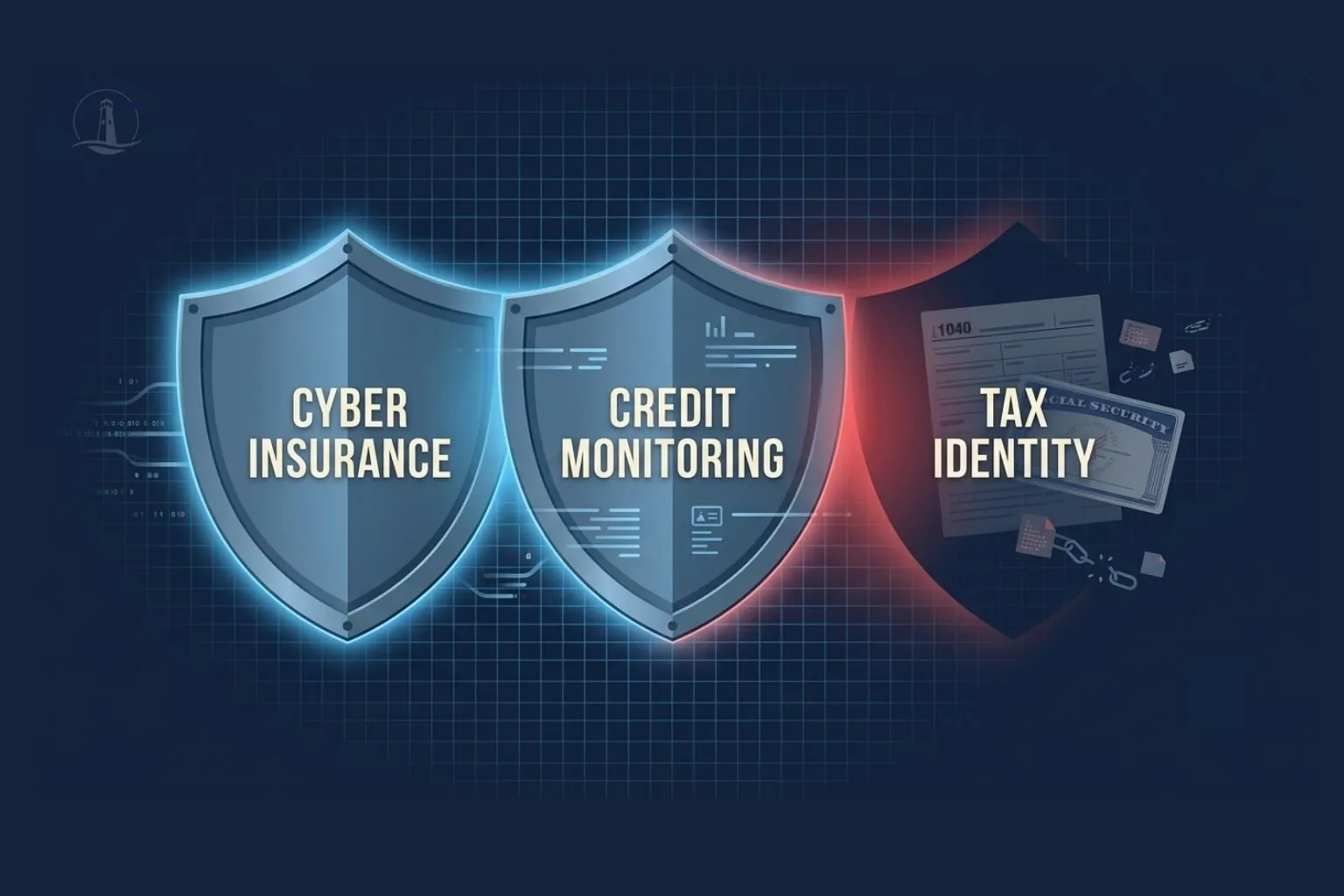
A more comprehensive protection strategy may include cyber insurance to protect the organization, credit monitoring to identify financial fraud, identity restoration services to assist victims, cybersecurity education to reduce exposure, and IRS Identity Theft Monitoring & Protection to help identify taxpayer-related fraud. Together, these solutions create broader protection than any individual service can provide alone.
Cyber insurance protects the business. Credit monitoring helps protect credit. IRS Identity Theft Monitoring & Protection helps address taxpayer identity risks. Each serves a different purpose, and together they create a more complete protection strategy.
Questions Every Employer Should Be Asking
As cyber threats continue to evolve, leadership teams should consider several important questions. If employee Social Security Numbers were exposed, how would the organization know if tax fraud occurred? Are employee protection programs focused exclusively on credit monitoring? What resources are available if an employee becomes a victim of tax identity theft? Does the organization’s benefits strategy address the full range of identity-related risks employees face today?
The answers to these questions may reveal gaps that many organizations have not previously considered. As cybercriminals continue to expand their tactics, employers may need to expand their protection strategies as well.
The Bottom Line
Cyber insurance remains one of the most important risk management tools available to organizations. Credit monitoring continues to provide meaningful protection against many forms of financial fraud. Neither solution should be viewed as unnecessary.
The challenge is that neither was designed to address every consequence associated with a stolen Social Security Number. As cybercriminals increasingly target taxpayer identities, organizations must broaden their approach to employee protection and post-breach risk management.
Credit monitoring helps identify credit fraud. Cyber insurance helps organizations recover from cyber incidents. Tax identity protection addresses a growing category of risk that often remains invisible until significant damage has already occurred.
For employers seeking to strengthen workforce protection and for carriers looking to deliver greater value, the question is no longer whether tax identity theft is a real risk. The question is whether existing protection strategies adequately address it.
For a growing number of organizations, the answer is no.
Frequently Asked Questions
What is tax identity theft?
Tax identity theft occurs when a criminal uses another person’s Social Security Number or taxpayer information to commit tax-related fraud. Common examples include filing fraudulent tax returns, stealing tax refunds, creating employment identity fraud, and accessing taxpayer information without authorization.
Does cyber insurance cover tax identity theft?
Most cyber insurance policies focus on organizational losses resulting from cyber incidents. While coverage varies by carrier, cyber insurance generally does not provide proactive monitoring of taxpayer activity within IRS systems.
Is tax identity theft different from credit identity theft?
Yes. Credit identity theft typically involves credit cards, loans, and financial accounts. Tax identity theft involves taxpayer records, tax filings, refunds, wage reporting, and interactions with tax authorities.
Why should employers care about tax identity theft?
Tax identity theft often creates productivity loss, employee stress, administrative burden, and financial hardship. Employers frequently become involved when employees need assistance resolving employment verification or wage reporting issues.
Can credit monitoring detect tax fraud?
Not always. Many forms of tax fraud occur outside the credit reporting ecosystem and may not trigger any credit bureau alerts.
What is IRS Identity Theft Monitoring & Protection?
IRS Identity Theft Monitoring & Protection focuses on identifying taxpayer-related fraud, refund theft, employment identity theft, unauthorized taxpayer activity, and other tax-related risks that traditional credit monitoring may not detect.
How does Tax Guardian complement cyber insurance?
Cyber insurance helps organizations recover after a cyber incident. Tax Guardian helps address taxpayer identity risks that may arise when Social Security Numbers and personal information are exposed, creating a more comprehensive workforce protection strategy.